 It’s October already and that means my brother Tom is getting married this weekend. And by married, I mean re-married. But as far as me, my mother, and two sisters are concerned, that detail is irrelevant. The race to find the right dress hasn’t changed a bit since his first wedding sixteen years ago.
Fortunately, unlike both my sisters, I don’t need to worry about what my daughter will wear. The two of them have been searching for appropriate outfits for an eleven-year-old and six-year-old girl. I, however, have that problem solved—thanks to Katie.
Last spring while shopping, Katie found a stiff, black satin skirt covered with opulent red and purple roses. It was beautiful and dramatic. A size larger than what she currently wore, I could picture it on my gorgeous daughter who has an eclectic and fearless sense of style. She insisted that I buy it. I protested—because really, where can an eleven-year-old wear a skirt like that? I will admit that fancy skirts requiring hand washing (or dry cleaning!) are not high on my list of must haves, even for me.
Katie pleaded and begged as much as an autistic child with limited verbal skills can beg. “It’s pretty,” she said. “Pretty flowers. I like that.”
 “Yes, it’s beautiful. You have excellent taste. But it’s just not practical, sweetie.”
I hate it when I say things my mother would say. Mom has always been extremely practical. I blame this on her Swiss ancestors. The Swiss are big fans of practicality and punctuality, and so is my mother.
“I want it,” Katie said. “Red flower skirt, please.” She locked her dove gray eyes on mine. “Pleeeeease.”
When Katie makes extended eye contact, I know she is pulling out all the stops. I sighed. I was in a hurry and didn’t want to argue about a satin skirt, beautiful or not. “Katie, you need to be really careful with a skirt like this. You have to take special care of it.”
“I do. I wear it. Pleeeeease.”
She began pulling the skirt over her pants. Apparently she thought a better visual of her in the skirt would convince me. I sighed again.
Katie twirled, gripping the skirt’s waistband to keep it from falling down. It flared out and I realized there was netting underneath. Katie didn’t realize it, but netting would overtax her sensory system. Even I find it scratchy and uncomfortable. I bent for a closer look. The netting was sandwiched between the skirt and a full lining, so it wouldn’t be a problem. I fingered the fabric. This was a nicely made skirt. It must be expensive as well as beautiful and impractical.
Katie pranced in the skirt, rubbing her hands over the satin. “It’s shiny. Sounds like….” She searched for the word.
“It’s swishy, Katie. The skirt makes a swishy sound.”
She smiled. “Shishy. Skirt is shishy!”
“It’s a nice sound, isn’t it?” I’d forgotten how delicious that sound was. Back in college I had a teal taffeta cocktail dress that made the exact same sound. I always felt beautiful wearing that dress.
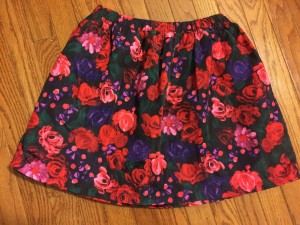 Katie nodded and I knew I’d have to buy her the skirt. I braced myself and looked at the tag. It was on clearance. Extreme clearance. As in, it cost $4.98. I laughed. For that price she could wear the skirt for dress up, maybe a couple Christmas parties, or even her birthday. I didn’t care. It was cheap enough that how often she wore it didn’t matter.
Except it did matter, because the skirt made my daughter blissfully happy. It would also make her feel special and beautiful, and an outfit that makes any of us feel that way is both priceless and (forgive me, Mom) practical.
Katie carefully carried the skirt to the register and I bought it for her. For seven months it’s been stored away, waiting for an appropriate occasion. Now we have one: my brother’s wedding.
Katie has already paired the “shishy” skirt with a black spaghetti-strap tank and a poppy red cardigan with lace trim that I previously bought at her insistence. It’s a gorgeous combination. She’s counting the days until she can wear her beautiful, and very appropriate, outfit.
If only the search for my dress had been as painless….
Until next time,
Cynthia


 I am thrilled to announce that my chapbook manuscript, entitled Across An Aqueous Moon: Travels in Autism, has been accepted for publication!


















A Slippery Legal Slope

But it is. And sadly, so are the neighbors.
A bit of background: Vidyut Gopal and Parul Agrawal, a Sunnyvale couple, have an eleven-year-old son diagnosed with autism spectrum disorder. Nearly two years ago, they were sued by the families living on either side of their house: Kumaran Santhanam and Bindu Pothen plus Robert and Marci Flowers. The suit claims the autistic child is a hazard to the other kids living on Arlington Court rising to the level of a public nuisance because he has exhibited aggressive behaviors consistent with his diagnosis. (According to the Autism Society, the behaviors in question are “nothing out of the ordinary” for those of us who live with the disorder.) The neighbors claim the autistic child’s presence on their street puts their children at risk and has lowered property values.
For starters, a nuisance is a condition, not a person. It’s an abundance of trash or a dog barking for hours. We don’t sue homeless people for being a nuisance, and we shouldn’t sue autistic children and their families either. Or any person who differs from the norm.
This lawsuit is the 21st Century equivalent of the Salem witch trials. What’s next? Burning autistic individuals at the stake because we fear them?
Rather than teaching their children tolerance and compassion, the neighbors on this street decided to punish and shame the disabled. Rather than helping a family fit in, they forced them out. Rather than asking what they could do to help, they made things much, much worse.
When I discussed this case with a friend, he said someone should sue the two families who filed the lawsuit. He said they did more to lower property values on their street than ten autistic kids. Because who wants to live near people who sue their neighbors?
He has a good point.
I find it interesting that whenever the media discusses this case, they feel compelled to point out that the child has been diagnosed with autism and is undergoing treatment. Well of course he is. All kids on the spectrum receive hours and hours of therapy each week. They also point out that he is medicated. Which makes me sad, because there really aren’t any medications for autism yet obviously the parents felt compelled to prove they were doing everything possible.
What the reporters don’t say is what the neighborhood kids were doing. How do we know they weren’t teasing or bullying the autistic child when he exhibited his so-called “menacing behavior?” Or simply touching him without permission? How come no one thinks to question their behavior? Why must the disabled child always be to blame?
The family with the autistic boy moved out of their home and now rent the house to others. Even if their child was a public nuisance (and I’m not saying he was), he clearly is no longer creating problems on Arlington Court. So why wasn’t the lawsuit dropped? One of the families who sued, the Flowers, moved a few months ago. And still the suit drags on.
This case presents a slippery slope, not only for families with autistic children, but for anyone who differs from their neighbors. Given the increased media attention this lawsuit has received of late, let’s pray it finally gets dismissed. Vidyut Gopal, Parul Agrawal, and their son have been punished long enough.
I hope their new neighbors, whomever they are, welcome them with open, and fully inclusive, arms.
Until next time,
Cynthia